Futures Past: Why We Can't Stop Romanticizing the Tomorrows That Never Arrived
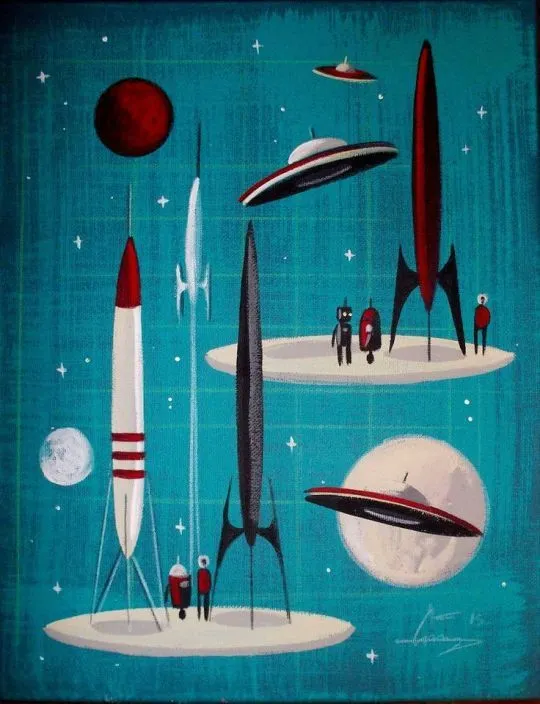
Photo: vintage retro futurism 1950s space age atomic design poster aesthetic, via i.pinimg.com
There's a specific flavor of aesthetic taking over Pinterest boards, Etsy shops, and indie game design right now, and it doesn't have a clean name yet. It's not quite retro-futurism — that term implies we still believe in the futurism part. It's something stranger: a deep, almost mournful affection for wrong predictions. For the flying cars that didn't materialize. For the gleaming silver jumpsuits of 1962 World's Fair promotional materials. For the Y2K computer aesthetic of translucent iMacs and frosted plastic, a design language built around a technological anxiety that turned out to be mostly a false alarm.
Call it Obsolete Futures. And it's everywhere.
The Aesthetic That Ate the Internet
Start paying attention and you'll see it constantly. The vaporwave movement — which peaked around 2015 but never really died — is essentially a visual elegy for 1980s and '90s visions of digital utopia, rendered in pastel gradients and Roman busts. Cottagecore's less-discussed cousin, "atompunk," romanticizes the Atomic Age's cheerful confidence that nuclear power would give every American family a personal helicopter by 1975. Y2K aesthetics have made such a thorough comeback that teenagers born after the millennium are buying translucent purple electronics on eBay as fashion statements.
And then there's the broader cultural appetite for media about old futures — the renewed interest in retrofuturist science fiction, the popularity of games like Fallout (whose entire visual language is predicated on a 1950s America that never stopped believing in atomic optimism), the resurgence of space-age mid-century modern design in home décor.
This isn't just nostalgia in the conventional sense. Nostalgia is longing for a past that existed. This is something more specific: longing for a past's imagination of the future. It's nostalgia for optimism itself.
Why Now, Specifically
The timing isn't accidental. The cultural turn toward Obsolete Futures has accelerated in roughly the same period that genuine futurism — the serious, wide-eyed kind — has become increasingly difficult to sustain.
Think about what actual near-future speculation looks like right now. Climate modeling. Antibiotic resistance timelines. AI displacement projections. The futures being seriously discussed in 2024 are, with some exceptions, not the kind that inspire mood boards. They're the kind that inspire therapy.
Contrast that with the futures being mourned in Obsolete Futures aesthetics. The 1950s space-age vision promised abundance, expansion, technological mastery over nature. The early internet utopians of the '90s promised radical democratization of information and human connection. Even Y2K, for all its anxiety, was premised on a world so thoroughly computerized and networked that the bugs in the system could bring civilization down — which is, in its own way, a kind of faith in technological progress.
Those visions were wrong in their specifics. But they were optimistic in their architecture. And that optimism is exactly what feels scarce right now.
The Grief Underneath the Kitsch
It's tempting to dismiss Obsolete Futures aesthetics as shallow trend-cycling — the culture industry recycling visual languages because originality is hard and nostalgia sells. And sure, some of it is exactly that. But there's something more sincere operating underneath the irony.
When a 24-year-old in Portland buys a vintage NASA recruitment poster or builds a playlist around the sonic palette of Fallout's in-game radio, they're not celebrating the specific predictions those artifacts made. They're reaching toward the confidence embedded in them. The casual assumption that the future was a place worth imagining in vivid, colorful detail. That humanity was going somewhere interesting and the trip would be worth taking.
Cultural critic Mark Fisher had a name for the broader condition: capitalist realism — the widespread sense that it's easier to imagine the end of the world than the end of the current social order. Obsolete Futures aesthetics might be understood as the pop-culture symptom of that diagnosis. If we can't genuinely imagine a better future, we can at least lovingly render someone else's failed attempt at one.
The Genre That Doesn't Have a Name Yet
What's genuinely new here — the thing that separates this moment from previous waves of retro appreciation — is the meta quality of the engagement. People consuming Obsolete Futures content aren't pretending the predictions were right. They're fully aware of the gap between the promise and the reality, and that gap is part of the aesthetic experience.
There's a word in Portuguese — saudade — that describes a melancholic longing for something that may never have existed, or existed only partially. Obsolete Futures is basically saudade for alternate timelines. For the 1999 that believed its computers might end civilization, and survived. For the 1965 that genuinely thought we'd have moon colonies by 1985. For any version of the future that felt like a destination rather than a deadline.
Some artists are working explicitly in this space. The indie game Disco Elysium built an entire political philosophy out of the ruins of failed utopian futures. Numerous Spotify micro-genres ("future funk," "synthwave," "hypnagogic pop") are essentially organized around the emotional texture of specific defunct tomorrows. Even prestige television has gotten in on it — For All Mankind on Apple TV+ runs the entire premise of an alternate history in which the space race never ended, and the show's appeal is almost entirely about the feeling of living in a world that kept believing.
Progress, Interrupted
Here at Zero Century, we've built an entire editorial identity around the premise that the future is happening whether we're paying attention or not. And that's still true. But Obsolete Futures as a cultural phenomenon is asking a harder question than "what's next?" It's asking why the people who came before us seemed so much more excited about finding out.
The answer, maybe, is that they hadn't yet accumulated the specific disappointments we have. They hadn't watched the early internet transform from a democratizing commons into a surveillance-and-advertising apparatus. They hadn't seen climate timelines get revised downward with each new report. They hadn't lived through the particular exhaustion of a world that keeps accelerating without seeming to improve.
So we root through their futures like a thrift store, looking for something still wearable. Something that carries the emotional residue of believing the next decade would be genuinely, structurally better than the last one.
Retro-futurism, in its classic form, imagined the future through the lens of the past. What we're doing now is different. We're imagining the past's future as a way of grieving our own. That's not a design trend. That's a cultural diagnosis.