Analog Is the New Luxury: How Gen Z Turned Rejection Into a Status Symbol

There's a disposable camera sitting on the kitchen counter of a 22-year-old in Austin, Texas. It's not a prop. It's not ironic. She bought it because she's tired of her phone knowing what she wants before she does.
This is the part nobody's writing the thinkpieces about — not really. Gen Z's turn toward retro technology gets framed constantly as aesthetic performance, a TikTok-fueled phase dressed up in vintage filters. But spend five minutes actually talking to the people buying $400 film cameras and flipping open Motorola Razrs in 2025, and a different story emerges. One that's less about nostalgia for a time they never lived through, and more about a very deliberate, very conscious refusal to be processed.
You Can't A/B Test a Polaroid
Here's the core tension: Gen Z is the first generation that never had a self that existed before the algorithm. Millennials at least remember dial-up chaos, a web that felt like a frontier rather than a funnel. Gen Z was born into a system that was already optimized, already watching, already building a dossier on their preferences from the first YouTube video they clicked at age nine.
So when a 20-year-old picks up a film camera, they're not cosplaying the 1990s. They're choosing a technology that is physically, structurally incapable of feeding data back into a machine that will use it to sell them something. A roll of Kodak Ultramax 400 does not have an engagement metric. It cannot be A/B tested. It produces 36 images and then it's done, and the algorithm gets nothing.
That's not nostalgia. That's sabotage.
The Opt-Out Tax
But here's where it gets complicated — and where the conversation usually stops being comfortable.
Opting out is expensive. A decent film camera setup will run you anywhere from $150 to well over $1,000 depending on how deep you go. Each roll of 35mm film costs between $12 and $20, and development adds another $15 to $25 on top of that. A vintage flip phone that doesn't connect to your social accounts sounds liberating until you realize you need to source one, unlock it, and accept that your Maps app is gone.
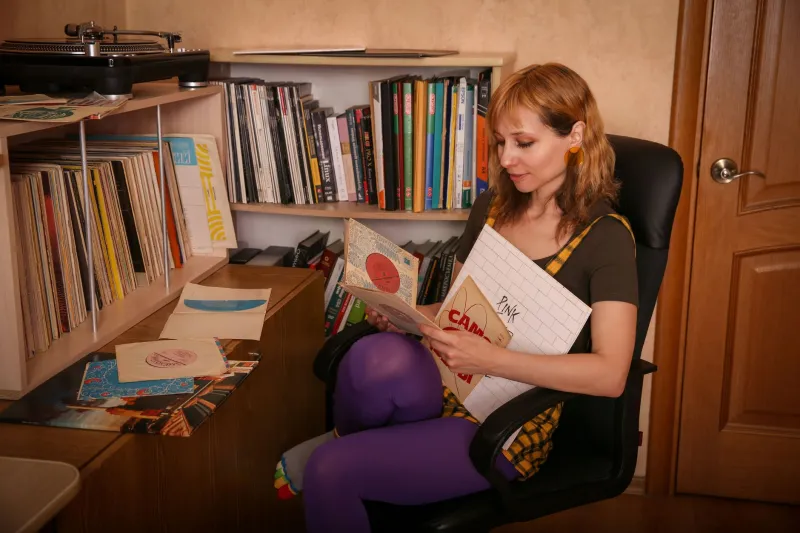
The 'analog lifestyle' — film photography, vinyl records, physical zines, dumb phones — has quietly become a luxury product. Not in the Chanel-bag sense, but in the way that organic food is a luxury: technically accessible to anyone, practically available only to those with disposable income and enough free time to deal with the friction.
What we're watching, underneath the aesthetics, is the emergence of a class of people who can afford to be inefficient. Who can afford to take 36 photos instead of 3,600. Who can afford to not be optimized.
The Friction Is the Point
Technology has spent the last two decades trying to eliminate friction. Every UX update, every one-click purchase, every autoplay feature exists to reduce the distance between impulse and action. And it worked. It worked so well that an entire generation grew up never having to sit with the discomfort of waiting, not knowing, or making a choice that couldn't be undone.
Film photography reintroduces all of that. You don't know if the shot is good until days later. You can't delete the blurry ones. You have a finite number of frames and you have to decide which moments are worth spending them on. For a generation raised on infinite scroll and unlimited storage, that constraint isn't a bug. It's the entire product.
Same goes for the flip phone revival. There are communities online — which, yes, the irony is not lost — dedicated to degoogling Android devices, sourcing vintage Nokia handsets, and building out 'minimal phone' setups that strip smartphones back to calls and texts. The pitch isn't that old phones are better. It's that old phones are dumber, and dumb, right now, feels like freedom.
Early Internet Aesthetics and the Myth of the Unmonetized Web
It's not just hardware. There's a parallel movement happening in digital spaces themselves — a Gen Z-driven obsession with early internet aesthetics. Geocities-style layouts. Guestbooks. Webrings. Sites that look like they were built in 2003 by a teenager who just discovered HTML and had approximately zero corporate guidance.
Sites like Neocities (a modern hosting platform explicitly modeled on the old Geocities) have seen significant growth among younger users who are building personal pages that look nothing like Instagram profiles and everything like the chaotic, hand-coded web of the early aughts. The appeal isn't the ugliness — it's the intentionality. Every blinking gif was a choice. Nobody's SEO strategy was involved.
What these aesthetics represent is a fantasy of a web that existed before the business model arrived. Before the platform decided what you should see and in what order and for how long. The early internet was messy and weird and often terrible, but it was also genuinely decentralized in a way that the current web — controlled by a handful of platforms with trillion-dollar market caps — simply is not.
Gen Z didn't live through that web. But they can feel its absence.
What This Reveals About Right Now
The retro tech movement, when you strip away the aesthetics and the class dynamics and the TikTok documentation of it all, is fundamentally a critique. It's a generation saying, loudly or quietly depending on who you're talking to, that the technological future that was built for them doesn't actually serve them.
That's a significant statement. These are people who grew up being told that more connectivity, more data, more optimization would make their lives better. And a growing number of them are concluding — not from ignorance but from direct, lived experience — that it hasn't. That the frictionless, personalized, always-on existence they inherited is exhausting in ways that are hard to articulate but easy to feel.
The flip phone on the nightstand is a vote. The roll of film is a vote. The hand-coded webpage with the visitor counter is a vote. None of them will change how Silicon Valley operates. None of them will dismantle the attention economy or restructure the data brokerage industry or make your FYP any less eerily accurate.
But they represent something real: a generation that was handed a future and is, in small and expensive and imperfect ways, trying to build a slightly different one from the parts that got left behind.
The future is still happening. Some people are just choosing to receive it on a 36-exposure delay.