Darkness as a Feature: Why People Are Paying $80 to Watch a Movie in a Room Full of Strangers
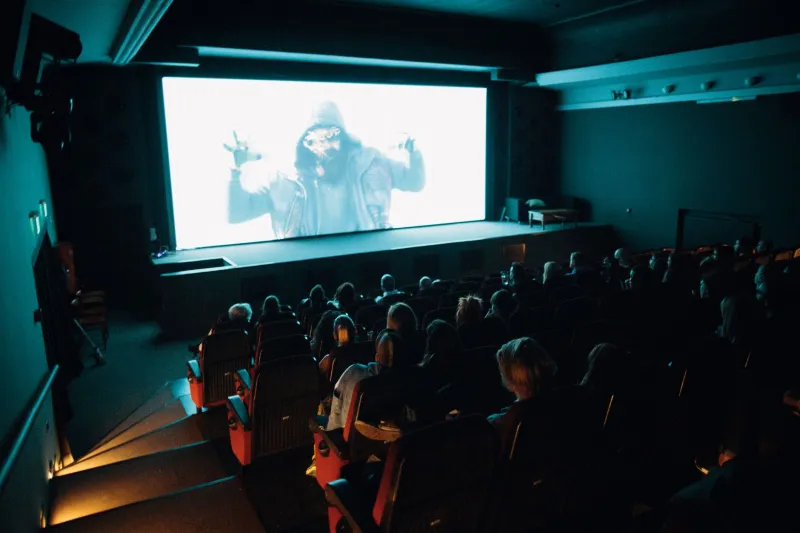
There's a specific kind of silence that happens about thirty seconds before a film festival screening begins. The house lights haven't fully dropped yet. Someone's phone buzzes once and gets immediately silenced — embarrassed, almost reverent. A stranger to your left shifts in their seat. And then it goes dark, and for the next two hours, nobody is going anywhere.
If you haven't experienced it lately, that probably sounds unremarkable. But in 2025, that silence is increasingly rare, increasingly intentional, and increasingly expensive. And people are paying for it like it's going out of style — which, depending on who you ask, is exactly why they're paying for it.
The Infinite Queue Problem
Streaming was supposed to solve cinema. More titles, more access, more convenience — the whole pitch was abundance. And it delivered. Netflix alone has somewhere north of 17,000 titles available in the US at any given moment. Disney+, Max, Hulu, Apple TV+, Prime — stack them up and you've got more content than any human could watch in several lifetimes.
So why does it feel like there's nothing to watch?
That's not a joke or a hot take. It's a documented psychological phenomenon sometimes called the paradox of choice, and the streaming era has turbocharged it into something almost pathological. When every option is available, the act of choosing becomes its own kind of labor. You spend forty minutes scrolling, settle on something mid-tier, and spend the whole runtime half-convinced you should be watching something else. The algorithm recommends what it thinks you'll finish, not what it thinks will change you.
Film festivals operate on the exact opposite logic. Someone — a human being with taste and a point of view — decided these films were worth your time. The schedule is fixed. The selection is finite. You either show up or you don't.
Scarcity as Luxury, Curation as Service
Ticket prices at major independent festivals have climbed steadily over the past five years. Passes to Sundance, SXSW's film programming, the New York Film Festival, and smaller regional events like Maryland Film Festival or Chattanooga Film Festival regularly run between $50 and $200 for multi-film packages — and that's before travel, lodging, or the $14 glass of wine at the venue bar.
Millennials are buying in anyway. Attendance at independent and regional film festivals has ticked upward since 2022, bucking the broader trend of theatrical decline. The demographic driving that growth skews 28 to 42, educated, urban or near-urban, and — critically — not underserved by streaming options. These aren't people who can't access films at home. They're people who are choosing not to.
"I have four streaming subscriptions," says one attendee at a recent regional indie festival in Austin. "I could watch something good tonight for free. But I drove two hours for this because I wanted someone to tell me what to watch. I wanted it to matter."
That word — matter — comes up a lot in conversations about the festival resurgence. There's a growing sense that the frictionlessness of on-demand viewing has inadvertently drained the experience of weight. When a film is always available, watching it never feels urgent. When a screening is one night only, in one room, with one audience, it becomes an event. The film doesn't change. The container does.
The Communal Screen
There's also something happening in that room that a living room simply can't replicate, and it's not just the screen size.
Laughter is contagious. So is tension. So is grief. Watch a horror film alone and you might flinch. Watch it with two hundred strangers who all flinch at the same moment and you've shared something — a small, wordless, collective experience that the algorithm cannot manufacture and a recommendation engine cannot deliver. Film scholars have written about this for decades. But millennials are apparently rediscovering it empirically, through the contrast of years spent watching prestige television alone in their apartments.
Some festivals have leaned into this deliberately. Post-screening Q&As have become a major draw, not just for the director access, but for the conversation they unlock between audience members. Venues that host discussion programming after screenings report higher return attendance. People aren't just coming to see films. They're coming to be in a room where films are taken seriously.
There's something almost defiantly pre-internet about the whole thing. The experience is deliberately unscalable. You can't replay it. You can't pause it. You absolutely cannot watch it at 1.5x speed.
The Pre-Algorithm Aesthetic
What's interesting is how this festival resurgence connects to a broader cultural moment that Zero Century has been tracking for a while — the growing appetite for experiences that exist outside the recommendation loop.
The algorithm is very good at giving you more of what you've already liked. It is structurally incapable of giving you something genuinely unexpected, something that reorients your taste rather than confirms it. Film festivals, by contrast, have always trafficked in the unexpected. A programmer puts a 90-minute Taiwanese slow-cinema piece on a Saturday afternoon slate and trusts that the audience will meet it halfway. Sometimes they don't. Sometimes they walk out changed.
That's not a bug in the festival model. It's the entire point.
Younger millennials who grew up with Netflix as a default are increasingly describing their streaming diet as "comfortable but flat." The festival experience offers texture — the discomfort of a film that doesn't care whether you like it, the challenge of subtitles and unfamiliar rhythms, the absence of a skip button when things get slow or difficult. It sounds like a complaint. People are paying eighty bucks for it.
What the Dark Room Tells Us
The film festival revival isn't really about movies. Or rather, it's not only about movies. It's about what we lose when everything is optimized for frictionless consumption — the sense that watching something was a decision, that the experience had edges, that you were present for it in a way that the algorithm couldn't track or monetize.
There's a reason people describe great festival screenings the way they describe live music or a really good meal. The unrepeatable quality is the value. You were there. It happened. It's yours now in a way that a saved Netflix title never quite is.
In a media landscape that has perfected the art of infinite availability, the deliberate scarcity of a festival screening starts to look less like a limitation and more like a gift. Someone curated this. Someone scheduled it. Someone decided it was worth two hours of your undivided attention in a dark room with strangers.
That's not nostalgia. That's a design choice. And right now, people are paying premium prices to opt into it — which tells you everything about what infinite choice actually costs.