Sacred Ground: The Indie Bookstore as America's New Church of the Unoptimized
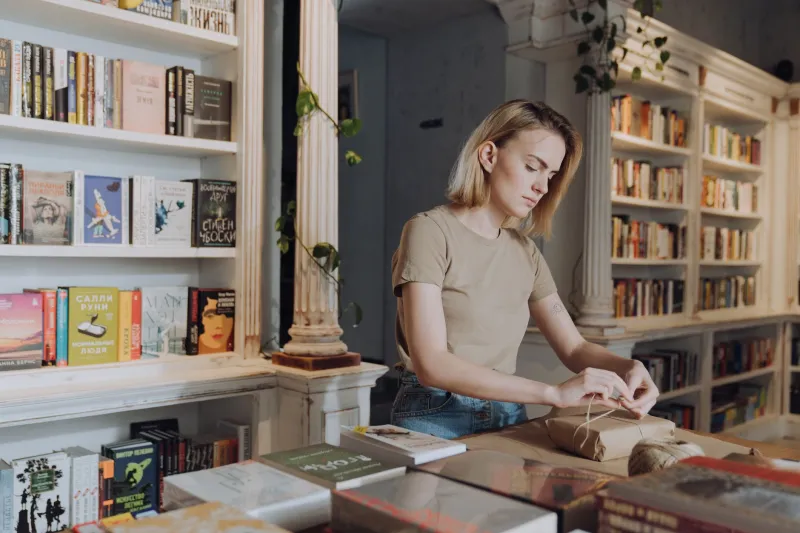
On a Saturday afternoon in Portland, a woman named Deja spends forty minutes in a cramped used bookstore on Hawthorne Boulevard. She buys nothing. She photographs two spines she'll probably never order online. She tells her friend afterward that it was, and this is a direct quote, "exactly what I needed."
This is not a rare occurrence. It is, quietly, becoming a defining ritual of a generation.
Millennials are returning to independent retailers — bookstores, record shops, vintage markets, hole-in-the-wall comic shops — in numbers that have surprised even the owners of these places. But the surprise isn't just the foot traffic. It's the behavior. People are lingering. Touching things they won't purchase. Staying for the vibe rather than the transaction. And in doing so, they're transforming what these spaces mean — not just commercially, but culturally.
The indie bookstore, in 2025, is no longer primarily a place to buy books. It's a sanctuary for people who are exhausted by being known.
The Algorithm Has a Profile on You. The Bookstore Doesn't.
Here's the thing about Spotify, Amazon, Netflix, and every other recommendation engine running your cultural life: they're very, very good at giving you what they think you want. They study your patterns, model your preferences, and serve up a feed of content calibrated to keep you engaged. It's efficient. It's also, for a growing number of people, suffocating.
When you walk into an indie bookstore — especially a good one, the kind with handwritten staff recommendation cards and a cat sleeping on the poetry section — nothing knows you're there. No algorithm adjusts the inventory to match your past purchases. The mystery section doesn't rearrange itself because you spent forty minutes reading a true crime deep-dive last Tuesday. The chaos is real. The serendipity is unscripted.
This is not a small thing. It might actually be everything.
There's a concept in psychology called "productive uncertainty" — the idea that not knowing what you're looking for is sometimes the most generative mental state you can be in. Indie retail, at its best, is a physical architecture built around productive uncertainty. You don't come in knowing what you want. You leave having discovered something you didn't know existed. That experience is increasingly rare in a world where every platform front-loads the familiar.
Pilgrimage Culture and the Meaning of the Trip
Religious scholars have long noted that pilgrimage isn't really about the destination. It's about the act of going. The journey itself — the inconvenience, the effort, the physical commitment — is what makes arrival meaningful.
Something structurally similar is happening with indie retail. Driving to Amoeba Music in Hollywood, or making the trip to The Strand in Manhattan, or hunting down that one record shop in your mid-sized city that keeps irregular hours and smells like old cardboard — these aren't efficient ways to acquire goods. They're rituals. The friction is the point. The effort signals to your own brain that this matters.
And increasingly, people are treating these trips with the same intentionality they'd bring to a day hike or a meditation retreat. They're blocking out time. Going alone or with one close friend. Leaving their earbuds at home. Treating the browse as an end in itself rather than a means to a purchase.
Some indie shop owners have started leaning into this explicitly. Bookstores in cities like Chicago, Austin, and Seattle have introduced what they're calling "slow shopping" afternoons — no staff hard-sell, no events, just open doors and good playlists. The message is clear: come in. Stay awhile. You don't have to buy anything.
And people are showing up.
The Museum Comparison Is Real, But It's More Complicated Than That
There's a tempting read on all of this that goes: millennials are treating indie bookstores like museums because physical retail is dying, and they want to experience it before it disappears. That's partially true, but it undersells what's actually happening.
Museums are archives. They preserve things that are finished. But a good indie bookstore is alive in ways a museum explicitly is not. The inventory shifts. The staff changes. The owner's taste evolves. The regulars age and new ones appear. What makes these spaces feel museum-like isn't that they're frozen — it's that they're intentional. Every item was chosen by a human being with a point of view, not surfaced by a ranking system optimized for conversion rates.
That intentionality is, itself, a form of curation that feels increasingly radical. In a landscape where cultural gatekeeping has been largely dismantled in favor of "let the market decide" algorithmic democracy, walking into a space where someone has made deliberate, opinionated choices about what belongs there feels almost transgressive. It's someone saying: I think this matters. I put it here because I believe in it.
That's not a museum. That's a manifesto.
What This Reveals About Where We Actually Are
The indie retail pilgrimage phenomenon is, at its core, a symptom of a specific kind of digital fatigue — not the kind that makes people want to throw their phones into the ocean, but the subtler, more pervasive exhaustion of living inside systems that always already know what you want.
The hunger for spaces that resist algorithmic curation is a hunger for a version of yourself that hasn't been modeled yet. The person you might become if you stumbled across the right book on the wrong shelf on a Saturday afternoon when you weren't looking for anything in particular.
There's something almost sci-fi about the inversion. We built recommendation engines to remove friction from discovery. And now people are driving across town specifically to reintroduce that friction, because it turns out discovery without friction isn't really discovery at all. It's just confirmation.
The bookstore that doesn't know you're coming is, in that sense, more future-facing than the platform that's been tracking you for a decade. Because it leaves room for something the algorithm can't simulate: genuine surprise.
Deja didn't buy anything that Saturday in Portland. But she went back the following weekend. She's been back four times since. Last month, she finally bought something — a novel she'd never heard of, by an author she couldn't have searched for, sitting face-out on a shelf like it had been waiting.
She says it's the best thing she's read in years.
Of course it is.